
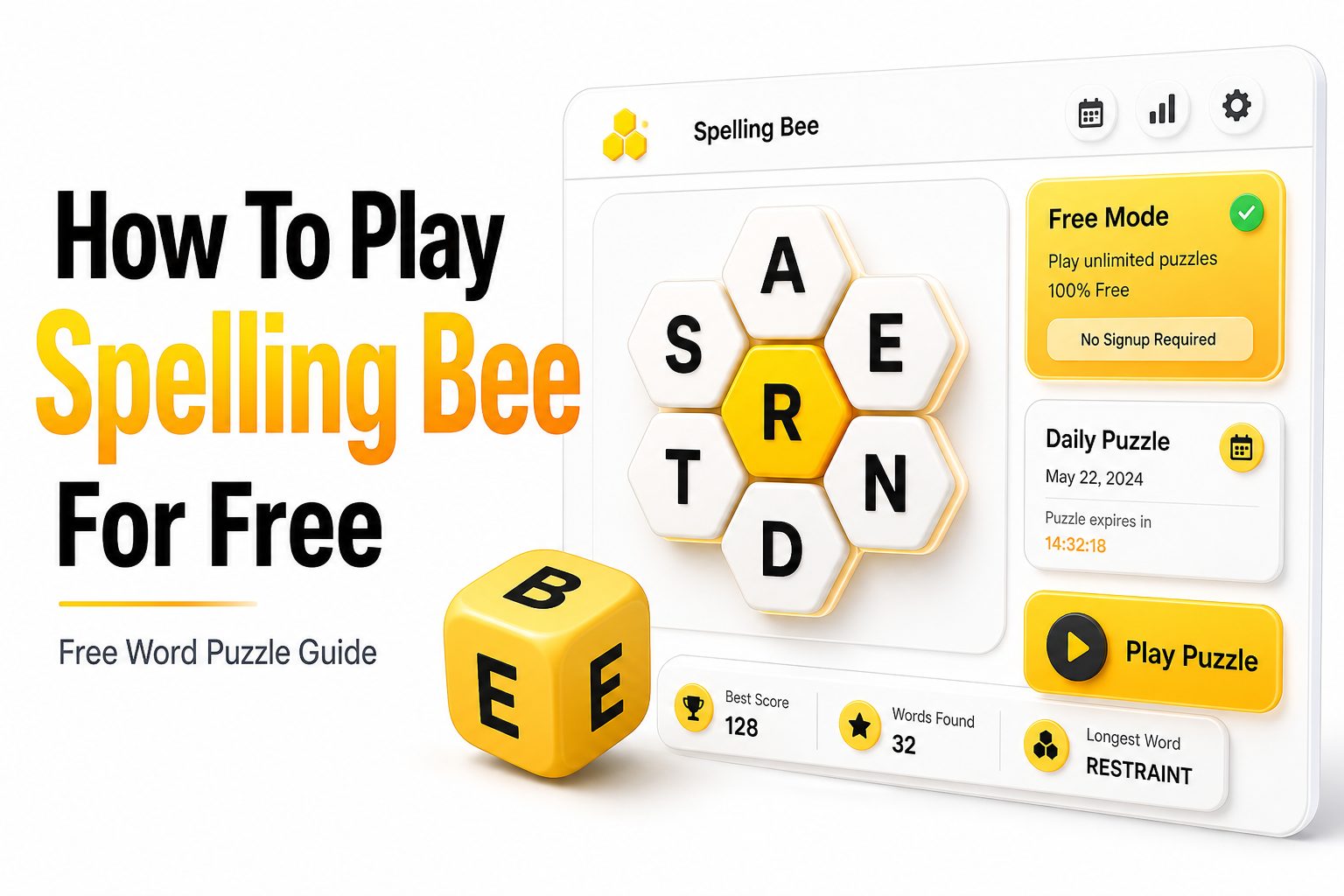
If you enjoy word games, spelling challenges, and daily puzzles, learning how to play spelling bee for free can give you hours of useful entertainment without adding another subscription to your budget. The appeal is simple: you build words from a small set of letters, test your vocabulary, and try to find the best possible combinations before your patience runs out.
Spelling bee games are also easy to start but surprisingly hard to master. A few letters can produce dozens of words, and the best players learn to spot prefixes, suffixes, uncommon endings, and hidden patterns. Whether you want a casual brain break, a classroom activity, or a daily vocabulary habit, free spelling bee games make word practice accessible. This article walks through the rules, where to play, how to improve, and how to get more value from every round.
What a Spelling Bee Word Game Is
A spelling bee word game usually gives you a group of letters and asks you to create as many valid words as possible. Most versions require every word to include a central letter, which makes the puzzle more structured and often more challenging than a standard anagram game.
The format is popular because it rewards both creativity and discipline. You can play quickly for a few minutes, or you can spend much longer searching for rare words. Free spelling bee puzzles are especially useful for players who want daily practice without paying for premium access.
How Free Spelling Bee Games Usually Work
Most free spelling bee games follow a simple rule set. You receive several letters, create words of a minimum length, and earn points based on word length or difficulty. Some games also include ranks, hints, timers, or daily puzzle streaks to keep the experience fresh.
The central-letter rule is what makes the game distinctive. If the required letter is “A,” every submitted word must contain “A.” This single restriction changes how you scan the letters and encourages more careful thinking than simply typing every word you notice.
Quick Benefits of Playing Free Spelling Bee Games
- Builds vocabulary through repeated word exposure
- Improves pattern recognition and spelling accuracy
- Offers a focused mental break without long setup
- Works well for students, adults, and casual players
- Encourages daily practice without requiring payment
- Helps players notice roots, endings, and word families
Best Ways to Play Spelling Bee for Free
The easiest way to play spelling bee for free is to use browser-based word game sites. Many offer daily puzzles, unlimited practice rounds, or basic versions with optional paid features. You can also find mobile apps that include free spelling bee modes supported by ads.
Another option is to create your own puzzle with paper or a shared document. Choose seven letters, mark one as required, and challenge yourself or friends to make words. This works especially well for classrooms, family game nights, and vocabulary practice sessions.
Free Online Platforms and Apps
Free word game websites are usually the fastest starting point. Look for games that clearly show the rules, accept common dictionary words, and allow enough free play to practice properly. A clean interface matters because word games depend on quick testing and easy revision.
Mobile apps can be convenient, but check whether the free version limits daily play. Some apps offer strong practice tools, while others restrict hints or puzzle access. Choose one that gives you enough rounds to build skill before considering any paid upgrade.
How to Start a Free Spelling Bee Puzzle
Begin by reading the rules before typing words. Check the minimum word length, required letter, scoring system, and whether plural forms are accepted. Small rule differences can change your strategy, especially when a puzzle rejects words that seem valid in everyday language.
Next, scan the letters for common short words. Do not worry about finding the longest word immediately. Early words help you learn the puzzle’s shape, reveal useful letter combinations, and build momentum before you search for less obvious answers.
Free Play Options Compared
Option | Best For | Main Advantage | Possible Limit
Browser game | Daily casual play | No installation needed | May limit hints
Mobile app | Playing anywhere | Easy access on phone | Ads or locked features
Printable puzzle | Classrooms and groups | No screen required | Manual checking needed
Self-made puzzle | Practice and teaching | Fully customizable | Needs word list support
Rules You Should Know Before Playing
Most spelling bee games require words to be at least four letters long. Proper nouns, abbreviations, hyphenated words, and offensive terms are usually excluded. Some platforms also reject obscure forms, even when those words appear in larger dictionaries.
The best word in many spelling bee puzzles is a pangram, which uses every available letter at least once. Finding the pangram often gives a large score boost. Not every free version uses the same scoring, but pangrams are still worth searching for first.
Common Scoring Systems
Many spelling bee games give one point for four-letter words and more points for longer words. A five-letter word may earn five points, while a seven-letter pangram may earn extra credit. This makes longer words valuable, but short words still matter.
Some free games use ranks instead of only raw scores. You might move from beginner to expert as you collect points. Ranks create a sense of progress and help you judge whether you have found most of the available words.
How to Find More Words Faster
Start with the required letter and pair it with every other letter. Then test common endings such as “ing,” “ed,” “er,” “en,” and “ly” when the letters allow them. This method gives your search structure instead of relying on random guesses.
You can also group letters by sound. Look for blends like “ch,” “sh,” “th,” “st,” and “tr.” Even when a blend is not available, thinking phonetically can help you hear possible words before you see them written out.
Simple Word-Finding Checklist
- Identify the required center letter first
- Make every valid four-letter word you can see
- Search for common endings and prefixes
- Try doubling letters when the game allows it
- Look for compound words and word families
- Save difficult letter combinations for a second pass
- Return later with fresh eyes if you get stuck
Smart Strategies for Beginners
Beginners often make the mistake of chasing rare words too early. It is better to collect obvious answers first. This builds points, reduces frustration, and gives your brain time to notice patterns that were not visible at the start.
A strong beginner strategy is to write or mentally list possible starting letters. Try each available letter in front of the required letter, then after it. This simple rotation can reveal familiar words that are easy to miss on the first scan.
Building a Daily Practice Habit
Playing one puzzle a day is enough to improve steadily. A short, focused session trains your memory without making the game feel like homework. Ten to fifteen minutes can be plenty, especially if you review missed words afterward.
Use a notebook or digital note to track words you did not know. Do not copy every answer list blindly. Pick five to ten useful words, learn their meanings, and try to use them in a sentence later that day.
Helpful Practice Routine
Practice Step | Time Needed | Why It Helps
First scan | 3 minutes | Finds obvious words quickly
Pattern search | 5 minutes | Builds word families
Pangram hunt | 5 minutes | Trains flexible thinking
Missed word review | 5 minutes | Expands vocabulary
Repeat next day | Daily | Turns skill into habit
How to Play Without a Paid Subscription
Many players search for how to play spelling bee for free because premium puzzle subscriptions are not always necessary. Free daily puzzles, trial-style versions, public word games, and homemade challenges can provide enough practice for most casual players.
The key is to separate entertainment value from extra features. Paid plans may add archives, advanced hints, or ad-free play, but the core skill comes from forming words. If your goal is vocabulary growth, free tools can be more than enough.
Using Free Trials Responsibly
Some platforms offer limited free access before asking for payment. If you use a trial, note what features you actually use. Archives and statistics are helpful for serious players, but they are not required for learning the game.
Avoid signing up for multiple trials without tracking renewal dates. A free game should stay free if that is your goal. Browser bookmarks, calendar reminders, and app store subscription settings can help prevent unwanted charges.
Making Your Own Spelling Bee Puzzle
Creating your own puzzle is straightforward. Choose seven letters, make one letter mandatory, and decide whether letters can be reused. Then set a minimum word length, usually four letters, and use a dictionary or word list to check answers.
For a fair puzzle, include at least two vowels and several common consonants. Letter sets with only rare consonants become frustrating quickly. A balanced mix creates enough word variety for beginners while still giving stronger players a challenge.
Classroom and Family Versions
Teachers can use spelling bee puzzles to support vocabulary, phonics, and spelling practice. Students can work alone, in pairs, or in small teams. The format encourages careful word construction without requiring long instructions or expensive materials.
Families can turn the game into a low-pressure challenge. Set a timer, compare word lists, and give bonus points for the longest word or best new vocabulary word. The focus should be friendly skill-building, not memorizing obscure terms.
DIY Puzzle Setup Tips
- Use seven letters with at least two vowels
- Mark one central letter as required
- Allow repeated letters unless you want a harder version
- Set four letters as the minimum word length
- Prepare a simple answer-checking method
- Give bonus points for a pangram
- Keep early puzzles easier for new players
Vocabulary Skills You Build While Playing
Spelling bee games strengthen more than spelling. They train players to recognize roots, prefixes, suffixes, and related word forms. When you notice that “tone,” “toned,” and “atoned” share patterns, you begin to see language as a system.
This kind of practice helps with reading and writing as well. A broader vocabulary makes it easier to understand context, choose precise words, and remember correct spellings. For students, the game can support classroom learning in a light, repeatable way.
Why Word Patterns Matter
Word patterns reduce the mental effort needed to find answers. Instead of treating every letter group as new, you learn reusable structures. Endings like “tion,” “ment,” and “able” become signals that lead you toward possible words.
Pattern recognition also makes the game less dependent on memorization. You still learn new words, but you also learn how English words are built. That skill carries over into crosswords, Scrabble-style games, spelling tests, and everyday writing.
Common Mistakes New Players Make
New players often ignore short words because they seem less impressive. That costs easy points. Four-letter words may not feel exciting, but they create the foundation of a strong score and often lead to longer related words.
Another common mistake is assuming a word is invalid because it sounds too simple. Free spelling bee games often accept ordinary words that players overlook. Try common verbs, adjectives, and everyday nouns before chasing unusual vocabulary.
Mistakes to Avoid
Mistake | Better Approach
Skipping short words | Collect them early for steady points
Guessing randomly | Search by letter patterns
Ignoring the required letter | Check every word before submitting
Quitting too soon | Take a break and return later
Relying only on hints | Build your own scanning routine
Memorizing lists only | Learn meanings and patterns
Using Hints Without Spoiling the Puzzle
Hints can be useful when you are stuck, but they work best in small doses. A hint that shows word length or starting letter keeps the challenge alive. A full answer list ends the puzzle before your brain has done the useful work.
If a free game offers limited hints, save them for later in the round. Try your own methods first. When you finally use a hint, treat it as a clue to a pattern rather than a shortcut to a single answer.
Better Alternatives to Full Answer Lists
Instead of opening an answer list, try sorting your found words by length. This shows where gaps may exist. If you have many four-letter words but few six-letter words, focus on adding prefixes, suffixes, or repeated letters.
You can also ask for a starting letter clue from a friend. This keeps the puzzle social without giving everything away. Small clues preserve the satisfaction of solving while still helping you move past a stubborn block.
Tips for Better Scores
- Search for the pangram early, then revisit it later
- Build from short base words into longer forms
- Test common prefixes such as re, un, in, and con
- Check whether the game accepts repeated letters
- Take short breaks during difficult puzzles
- Review missed words after finishing
- Practice regularly instead of playing one long session
Playing Spelling Bee on Mobile Devices
Mobile spelling bee games are ideal for short sessions during commutes, breaks, or waiting periods. A good app should have responsive controls, clear letter buttons, and a simple way to shuffle letters. Shuffling is especially helpful when your eyes stop seeing new combinations.
Watch for aggressive ads or limits that interrupt play too often. Free apps need support, but the best ones keep ads between rounds rather than during word entry. A clean playing flow makes practice more productive and less frustrating.
Browser Play on Phones
Browser-based spelling bee games can work well on phones if the layout is mobile-friendly. Look for large letter tiles, readable scoring, and quick word submission. If a page feels cramped, rotate your phone or try another site.
Saving a browser game to your home screen can make it feel like an app without installing anything. This is a practical choice if you want free access, minimal storage use, and fewer app permissions on your device.
How Kids Can Benefit From Free Spelling Bee Games
Children can use spelling bee games to practice vocabulary in a playful format. The puzzle structure encourages experimentation, and repeated exposure helps reinforce spelling patterns. For younger players, adults can reduce pressure by focusing on effort and word meanings.
Free games are also useful because parents and teachers can test different difficulty levels before committing to paid tools. Start with easier letter sets, allow teamwork, and celebrate new words learned rather than only the final score.
Safe Practice for Younger Players
For kids, choose ad-light sites or offline versions when possible. Some free game platforms include unrelated ads or links, so adult supervision matters. Printable or homemade puzzles offer more control and remove distractions entirely.
You can also connect the puzzle to reading assignments. Pull letters from a story’s vocabulary words, then ask students to form related terms. This creates a clear learning purpose while keeping the activity short and engaging.
Kid-Friendly Setup Ideas
- Start with common letters and simple vowels
- Use a shorter timer or no timer at all
- Let children work in pairs
- Review new words after the round
- Award points for definitions, not only spelling
- Use printable puzzles when screen time is limited
How Adults Can Use Spelling Bee for Brain Training
Adults often play spelling bee games for relaxation, but the mental benefits are real. The game trains attention, memory, flexible thinking, and vocabulary recall. It is challenging enough to feel rewarding without requiring complex rules or long sessions.
A daily word puzzle can also become a healthier break than scrolling. Because the task is focused, it gives your mind something specific to solve. Even five minutes of active word searching can feel more satisfying than passive screen time.
Keeping the Challenge Fresh
If the game becomes too easy, add your own limits. Try finding the pangram before any other word, reaching a score target without hints, or writing definitions for unfamiliar answers. These small rules make free play more demanding.
You can also rotate between different spelling bee platforms. Each game may use a slightly different dictionary or scoring model. Switching occasionally exposes you to new accepted words and keeps your practice from becoming too predictable.
Free Spelling Bee Versus Other Word Games
Spelling bee games are different from crosswords because they do not depend on clues. They are also different from Scrabble-style games because there is no board position or opponent. The challenge comes from letter constraints and vocabulary depth.
This makes spelling bee a strong choice for solo practice. You can play at your own pace, pause anytime, and return later. For people who enjoy word searches but want more active thinking, spelling bee puzzles offer a useful middle ground.
Choosing the Right Word Game
Game Type | Best Strength | Best Player Fit
Spelling bee | Word formation | Vocabulary builders
Crossword | Clue solving | Trivia and language fans
Word search | Visual scanning | Casual relaxation
Anagram game | Fast rearranging | Quick pattern thinkers
Scrabble-style game | Strategy and scoring | Competitive players
How to Review Missed Words
Reviewing missed words is where real improvement happens. After a puzzle, look at the answers you did not find and group them by pattern. You may notice that you missed repeated letters, certain endings, or words beginning with one specific consonant.
Do not try to memorize every missed answer. Choose the words most likely to appear again or improve your vocabulary. Learning ten useful words well is better than glancing at fifty obscure words and forgetting them the next day.
Turning Missed Words Into Practice
Write each selected word with a short definition. Then create one sentence that uses it naturally. This small step connects spelling to meaning, which makes the word easier to remember and more useful outside the game.
For more practice ideas, see our word game strategies resource and our vocabulary-building tips page. These internal resources can support players who want a broader approach to spelling, reading, and daily language improvement.
When Paid Versions Might Be Worth It
Free spelling bee games are enough for many players, but paid versions can make sense for heavy users. Archives, advanced statistics, cleaner interfaces, and deeper hint systems may be worth paying for if you play every day.
Before upgrading, ask what problem the paid version solves. If you only want casual practice, free access is probably sufficient. If you want historical puzzles, progress tracking, or fewer interruptions, a subscription may offer practical value.
How to Decide Before Paying
Try the free version for at least a week. Notice whether you run out of puzzles, feel limited by hints, or dislike the ads. A short test period gives you better evidence than upgrading after one enjoyable round.
Also compare several free alternatives first. Some players find that a mix of browser puzzles, mobile apps, and homemade games covers their needs. Paying should improve your routine, not simply feel like the only way to keep playing.
Decision Checklist Before Upgrading
- You play several times per week
- Free limits interrupt your routine
- Archives matter to your practice style
- Ads make the game hard to enjoy
- You want detailed progress tracking
- The price fits your entertainment budget
- You have compared free alternatives first
Conclusion
Spelling bee games remain popular because they are simple to begin, satisfying to improve at, and flexible enough for many kinds of players. You can use them for vocabulary practice, classroom activities, family challenges, daily brain training, or quiet personal entertainment. The rules are easy, but the best puzzles keep asking you to look again, test another pattern, and rethink familiar letters.
The best way to improve is to build a steady routine. Start with short words, search for patterns, use hints carefully, and review the words you miss. Free websites, apps, printable puzzles, and homemade versions all give you practical ways to play without pressure. If your goal is to learn how to play spelling bee for free, start with one accessible puzzle today and let regular practice do the rest.
FAQ
Can I play spelling bee without signing up?
Yes, many browser-based spelling bee games let you play without creating an account. Some may limit features, hints, or archives, but basic daily puzzles and practice rounds are often available for free.
What is the easiest way to get better?
Start by finding all short words first, then build longer words from them. Look for common prefixes, endings, repeated letters, and the required center letter. Reviewing missed words after each game helps improvement happen faster.
Are free spelling bee games good for kids?
Yes, they can help kids practice spelling, vocabulary, and word patterns. Parents or teachers should choose age-appropriate puzzles, avoid distracting sites, and focus on learning new words instead of only earning a high score.
What does pangram mean in spelling bee?
A pangram is a word that uses every available letter in the puzzle at least once. Many spelling bee games award bonus points for finding it, making it one of the most valuable answers in a round.
Do I need a dictionary while playing?
You do not need one during casual play, but a dictionary is useful after finishing. Looking up missed words helps you learn meanings, remember spellings, and recognize similar patterns in future spelling bee puzzles.
0 Comments